


Mental health in the automotive industry
Call us free on 08081 311 333 or chat with us online - we're here for you.
Every year, Ben surveys thousands of people who work, or have worked, in the automotive industry to understand the real state of their health and wellbeing. Now in its eighth year, the survey is the largest and most consistent picture we have of what workers across the sector are experiencing.
The 2025 findings make for difficult reading. Mental health scores across the industry have declined for the second year running, the gap between automotive workers and the rest of the UK workforce has widened, and just one in two people would recommend their employer's wellbeing support to a colleague.
This article sets out what the data shows - and what it means for everyone who works in the sector.

The headline numbers
Of the 1,159 automotive workers who took part in Ben's 2025 survey, 99.8% reported being affected by at least one health or wellbeing issue in the past twelve months. That is not a selective finding - it reflects the breadth of pressures the sector places on the people who work in it.
The five most commonly reported issues were:
- Stress at home or work - 57% (up 1% year on year)
- Poor sleep - 52% (up 1%)
- Feelings of anxiety - 44% (up 1%)
- Not taking time to rest and relax - 43% (up 4%)
- Low mood - 41%
Feelings of depression were reported by 33% of respondents - one in three.
Mental health is getting worse
The survey tracks mental health scores on a scale of 0 to 10. In 2024/25, the average score for automotive workers was 6.1 out of 10 - down from 6.4 the previous year. For context, the average UK worker score is 6.4.
That gap - 0.3 points between automotive workers and the wider UK workforce - may sound small. But it represents a consistent, multi-year divergence that has been tracked across eight waves of this survey.
More significantly, automotive workers now score lower on mental health than workers in any other UK sector surveyed.

What is driving workplace stress?
The survey asks workers to identify what is causing stress at work. In 2025, the top five drivers were:
Work-life balance - 48% (up from 44%)
High workload - 47%
Not enough staff - 37%
Long hours - 36% (up nine percentage points in a single year)
Targets and performance pressure - 30%
The rise in long hours as a stress driver - up from 25% to 36% in twelve months - is one of the most significant year-on-year changes in the data.
Where the gap is widest
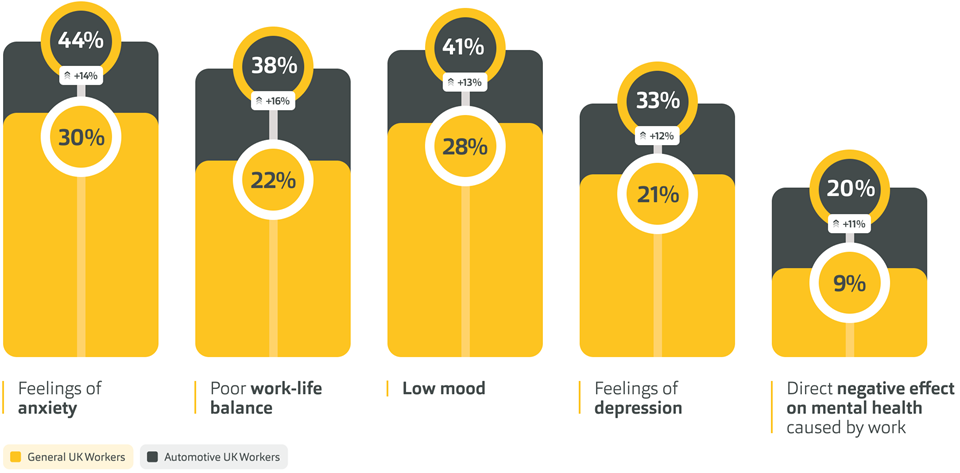
Compared with UK workers generally, people in the automotive sector consistently report higher rates of almost every mental health concern. The disparities are most pronounced in:
- Feelings of anxiety: 44% vs 30% of UK workers (+14 percentage points)
- Poor work-life balance: 38% vs 22% (+16 pp)
- Low mood: 41% vs 28% (+13 pp)
- Feelings of depression: 33% vs 21% (+12 pp)
- Direct negative effect on mental health caused by work: 20% vs 9% (+11 pp)
Perhaps the starkest single finding is on presenteeism. Four in five automotive workers (78%) have come into work despite being mentally or physically unwell — compared with three in five (60%) of UK workers. People in the industry are consistently working through illness at rates significantly higher than the national norm.
Work-life balance is a particular pressure point. Only 46% of automotive workers say they have a good work-life balance, against 62% of UK workers - a gap of 16 percentage points that has remained stubbornly wide across recent survey waves.

Where you work makes a difference
The 2025 survey breaks mental health scores down by working environment, and the variation is significant.
Home-based workers report the highest average mental health score at 6.8 out of 10 - and this group is improving, up 0.5 points year on year. Factory workers also saw improvement, up 0.7 points.
At the other end of the spectrum:
- Dealership workers: 5.7 (down 0.8 - the largest decline of any working environment)
- Warehouse workers: 5.7 (down 0.2; with sharp rises in depression, isolation and anxiety)
- Garage workers: 5.8 (down 0.6; stress and poor sleep both rising significantly)
- Showroom workers: 6.2 (down 0.4)
For people working in dealerships, garages and warehouses, the 2025 data paints a particularly difficult picture - one that has worsened meaningfully in a single year.
Retention: nearly half of those considering leaving cite mental health
One in four workers (24%) are considering leaving the automotive industry. Of those, the most common reason - cited by 49% - is mental health. That makes poor mental wellbeing the single biggest driver of potential attrition across the sector, ahead of financial reasons (26%), wanting to try a different industry (29%), and physical health concerns (12%).
1 in 9 workers report being personally affected by a lack of mental health support in their workplace. This isn't a background concern - it is directly influencing whether people stay.

Employer support is declining
For the third consecutive year, the employer Net Promoter Score for mental health and wellbeing support has declined. In 2024/25 it sits at -17 - meaning significantly more workers are actively negative about their employer's support than positive.
- 42% are detractors - they would not recommend their employer's wellbeing support
- 25% are promoters
- Just 54% of managers are checking in on how their team is feeling, down from 60% the previous year
The most common reasons workers do not recommend their employer's wellbeing support: a lack of genuine care (40%), inconsistent mental health support (35%), and a toxic workplace culture (25%).
Workers were also asked what would improve things. The most-requested actions: more open conversations about mental health, regular one-to-one check-ins with managers, and drop-in wellbeing clinics.
Free support from Ben
The findings from this survey are the reason Ben exists. For over a century, we have provided free, confidential support to everyone in the automotive industry - and that support has never been more needed.
If you're affected by any of the issues in this survey, you don't need a referral, a diagnosis, or a clear sense of what's wrong. You just need to reach out.
What we offer:
- Free, confidential helpline: 08081 311 333 call or chat online, any time
- SilverCloud - digital mental health programmes - free, 24/7 CBT-based programmes for stress, anxiety, depression and sleep (access code: ben)
- Mental health self-assessment - a short quiz that gives you personalised guidance on the right support for you
- Counselling and life coaching - one-to-one support from a trained professional, free of charge
- Money and mental health support - if financial pressure is part of what you're dealing with
If anxiety, depression, stress or poor sleep are affecting you, we have dedicated guidance and support for each.
You can also visit our mental health hub for a full overview of what's available.

Download the full survey
The full findings from Ben's 2025 Annual Health & Wellbeing Survey are available to download, including sector breakdowns, working environment data, and the full year-on-year trends.